
💔 The Unseen Danger in Every Dachshund Waddle: Why Standard Braces Fail Your "Weenie Dog" (And the Bracing Solution That Restores Hope)
Every Dachshund owner lives with a silent, heavy fear: Intervertebral Disc Disease (IVDD). That delightful, low-to-the-ground waddle, the comical sight of their short legs motoring a long body—it brings us so much joy, but it's also a constant reminder of the fundamental weakness in their unique anatomy.
Your Dachshund isn't built like other dogs. Their short legs and long back—a characteristic known as chondrodystrophy—make them uniquely susceptible to disc rupture and potential paralysis.
If you’ve heard the vet mention IVDD, or perhaps you're already managing a flare-up, you know the stakes. It's the difference between a dog who runs, plays, and cuddles, and one who might be permanently immobilized and in pain. Knowing this, why would you trust a generic, "one-size-fits-all" back brace—a product built for medium-sized mutts or boxy breeds—to protect the one feature that makes your Dachshund special, yet uniquely vulnerable?
Standard, boxy braces miss the mark. They slip, they twist, they cause painful pressure points, and worst of all, they fail to offer true, stabilizing support where your Dachshund needs it most. The result? Continued anxiety for you and continued risk for them.
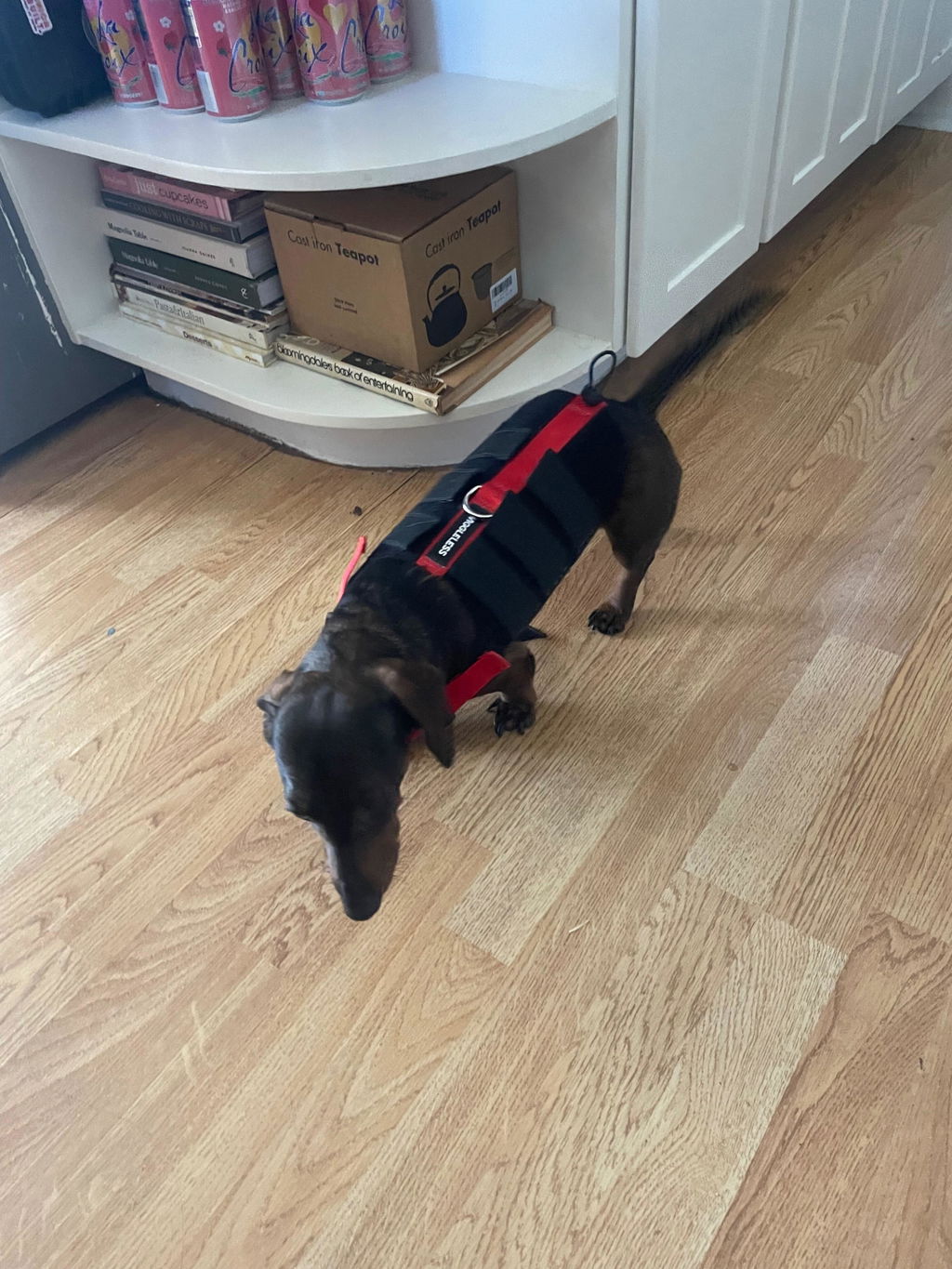
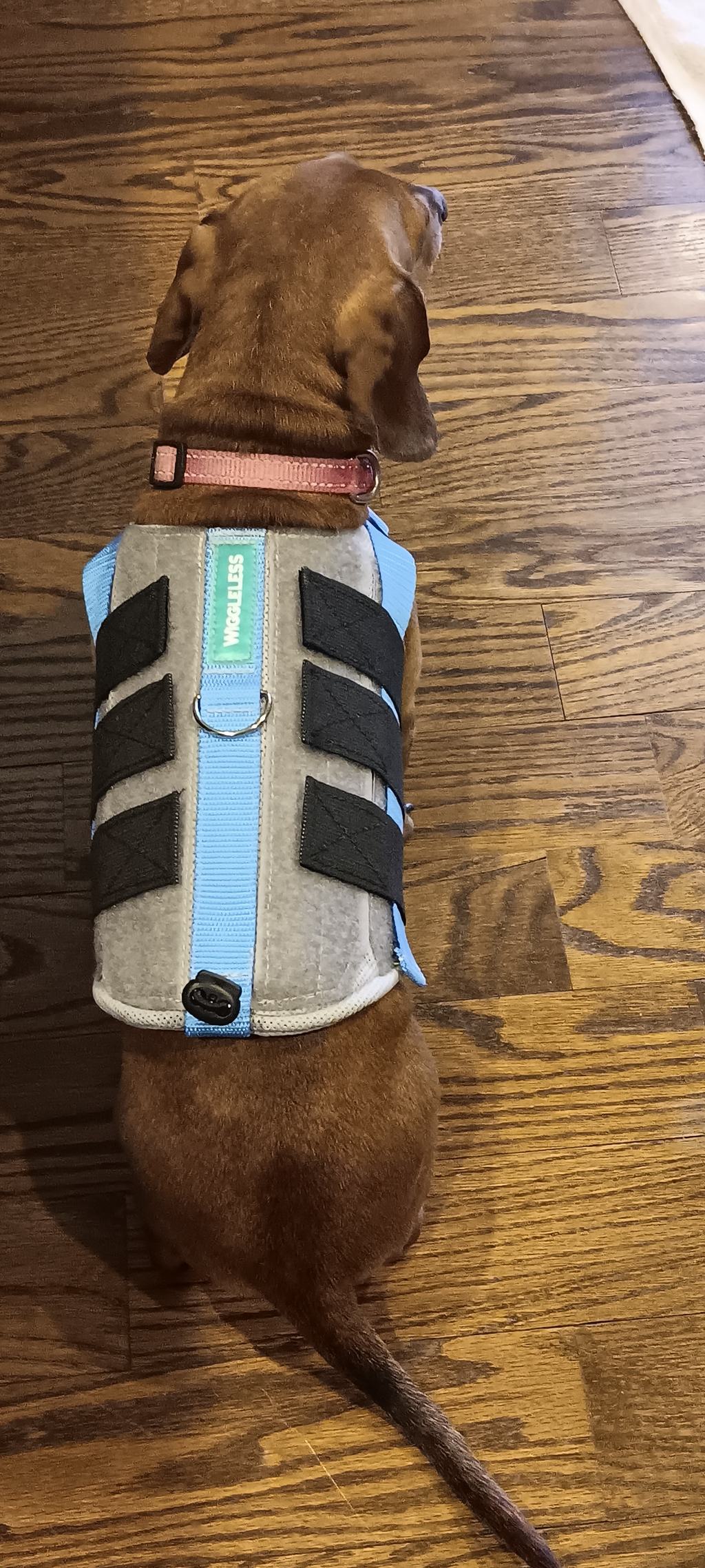
This post will deeply explore the anatomical problem, detail why generic solutions fail, and introduce the specialized support system engineered specifically for the Dachshund body: The Wiggleless Back Brace.
I. The Emotional & Anatomical "Why": Understanding the Dachshund’s Burden
To truly solve the problem, we must first understand the Dachshund’s unique physiology and the emotional impact of their vulnerability.
A. The Dachshund Anatomical Imperative
The term chondrodystrophy simply means "abnormal cartilage growth." In Dachshunds, this results in the elongated vertebral column and the characteristic short limbs. This is not just a cosmetic feature; it is a structural liability.
The Spine as a Bridge: Imagine your dog’s long back as a bridge supported by very short pillars (their legs).
-
Standard Dogs: The bridge is short, and the weight distribution is efficient.
-
Dachshunds: The bridge is excessively long. Even minor movements, like jumping off a sofa or twisting quickly to chase a toy, place immense shearing forces on the discs (the shock absorbers between the vertebrae). These discs often calcify prematurely, making them brittle and prone to rupture—the definition of Type 1 IVDD.
B. The IVDD Cycle: Why Prevention is Critical
IVDD is not just a sudden event; it is often a progressive disease exacerbated by repeated mechanical stress.
When a disc ruptures, it presses on the spinal cord, causing pain, loss of coordination, and potentially paralysis. For the owner, this crisis moment is terrifying, often resulting in expensive emergency surgery or months of crate rest.
The Role of Support: During rest or recovery, the goal is immobilization. But even during normal, daily activity, stabilization is key. A supportive brace must do one job above all else: prevent the spine from moving in any direction that could stress a disc.
This leads us to the critical failure point of generic solutions.
II. The Failure of Generic Braces: Why "One-Size" Is Unsafe for Dachshunds
Generic back braces are designed for the "average" dog—a relatively square body where the length and girth are proportional. Trying to fit this design onto a Dachshund is like trying to wear clothes meant for a completely different shape. The brace cannot do its job safely.
A. The Two Most Dangerous Flaws in Generic Bracing
1. The Girth-to-Length Mismatch (The Sliding Problem)
Dachshunds have deep chests that taper sharply toward their back legs. Standard braces, which are typically uniform rectangles or simple cylinders, cannot accommodate this taper.
-
The Result: The brace becomes loose around the abdomen and hips while potentially being too tight around the chest. This instability allows the brace to shift back and forth, rubbing against the skin and, crucially, allowing the spine to move excessively (hyperextend or flex) within the brace itself. This movement is exactly what you are trying to prevent.
2. Allowing Spinal Torsion (The Twisting Hazard)
This is the most critical failure point. Spinal torsion—the side-to-side twisting movement—is a primary trigger for IVDD flare-ups.
Generic braces stabilize the back primarily along the top and bottom. Because they are not securely locked into the unique "long and low" structure of the Dachshund body, they provide minimal lateral (side-to-side) stability.
-
The Result: When your Dachshund turns quickly, navigates a tight space, or attempts to adjust their position, the brace can move slightly, allowing the spine to twist within the support structure. This small, uncorrected twisting can be the straw that breaks the camel’s back, initiating a painful disc event.
The takeaway is clear: For Dachshunds, safety cannot be achieved with approximation. It requires precision engineering.
III. The "What": Precision Engineering for the Chondrodystrophic Body
The Wiggleless Back Brace was born from the frustrating realization that a truly safe, effective support for Dachshunds did not exist. We focused on the precision of fit—the Big Idea that makes this product uniquely successful.
A. The Wiggleless Solution: The 3-Axis Adjustment System
We didn't design this brace for dogs; we engineered it specifically for the chondrodystrophic body. Our goal is simple: total, unyielding spinal support that prevents those dangerous gaps and eliminates rotational movement.
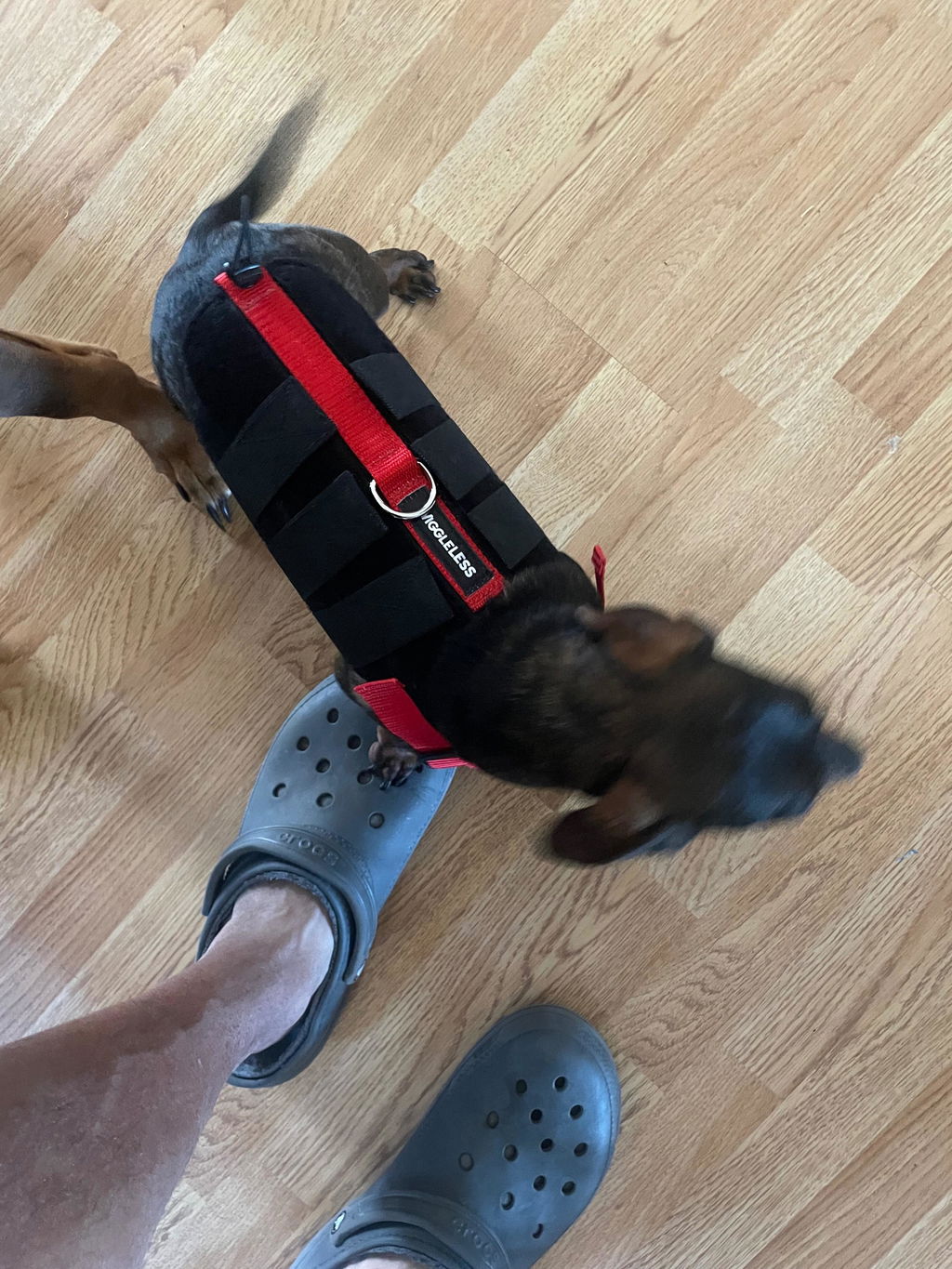
The 3-Axis Adjustment System means we account for three dimensions of fit critical to a Dachshund:
-
Axis 1: Length (Preventing Hyperextension): Adjustable length ensures the brace spans the entire crucial thoracic and lumbar spine without inhibiting necessary neck or tail movement.
-
Axis 2: Girth (Preventing Shifting): Multiple, independent adjustment points ensure the brace conforms to the chest and the tapered waist separately, locking the brace to the body.
-
Axis 3: Lateral Stability (Eliminating Torsion): The combined secure fit across all points creates a rigid external structure that prevents side-to-side twisting better than any generic design.
B. Feature-to-Benefit Breakdown: Five Points of Proof
We replace the dangerous approximation of two adjustment points with the certainty of five:
| Wiggleless Feature | Anatomical Focus | Direct Benefit to Your Dachshund |
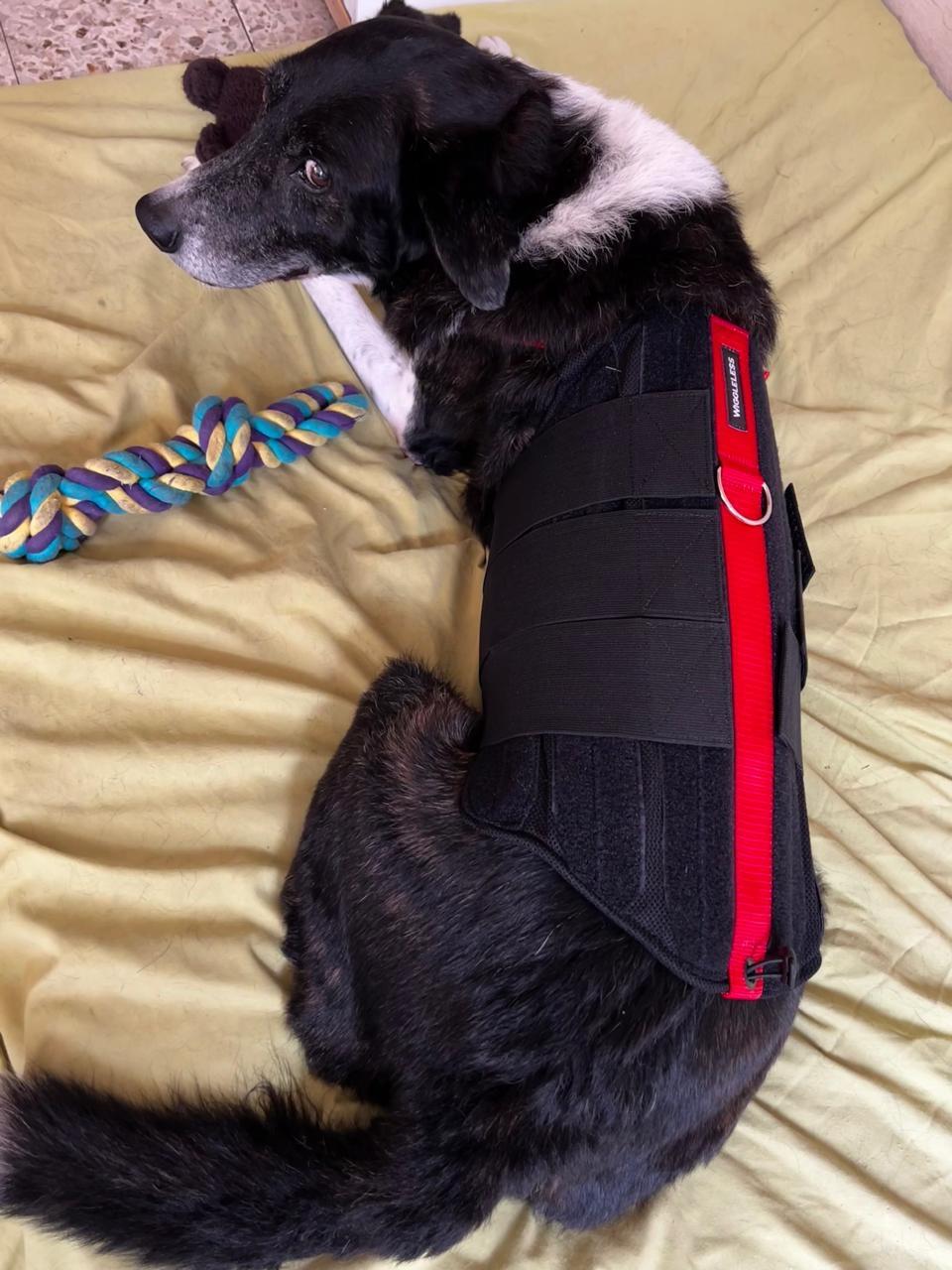
| Two independent Neck/Shoulder Adjustments | Securing the Cervical-Thoracic Junction | Prevents Forward Slippage. Locks the front of the spine into neutral alignment during movement. |
| Two independent Abdominal/Hip Adjustments | Securing the Lumbar-Sacral Junction (The Taper) | Eliminates Shifting. Conforms to the tapered waist, preventing the brace from sliding back and forth. |
| Single Central Length Sizing | Thoracic/Lumbar Spine Coverage | Custom Length. Ensures the entire critical span of the spine is supported without restricting movement at the very front or back. |
| Rigid Internal Splints | Spinal Column Support | Flexible Immobilization. Provides the necessary stiffness to hold the spine steady during rest or controlled activity. |
| Breathable, Non-Chafe Material | Skin Health and Comfort | High Compliance. The dog will wear it longer, promoting continuous healing and safety. |
This level of customization means that once fitted, the Wiggleless Back Brace becomes an extension of your Dachshund’s body, offering a stability that simply cannot be achieved with a generic, boxy design.
IV. The Path to Peace: Testimonials and Risk Reversal
We are selling not just a brace, but the peace of mind that comes from knowing you have given your cherished pet the absolute best chance at a pain-free, active life.
Proof in Practice: Stories of the Wiggleless Difference
"Before Wiggleless, Henry’s old brace would shift every time he lay down, and I constantly feared he'd twist. Now, the five adjustment straps lock him in place like a custom suit. He's been seizure-free for nine months, and the confidence that gives me is priceless." – Sarah T., Owner of Henry (10-year-old Mini Dachshund)
"The key was the tapered fit. Leo has a huge chest but a tiny waist, and every other brace rubbed his armpits raw. Wiggleless is the only one that conforms properly. He is walking short distances again, and he never fights wearing it." – Mark D., Owner of Leo (7-year-old Standard Dachshund)

Always consult your Veterinarian to find the best solutions for your pet.